How to Create a Peaceful Homeschool Atmosphere with Positive Parenting
Jun 06, 2026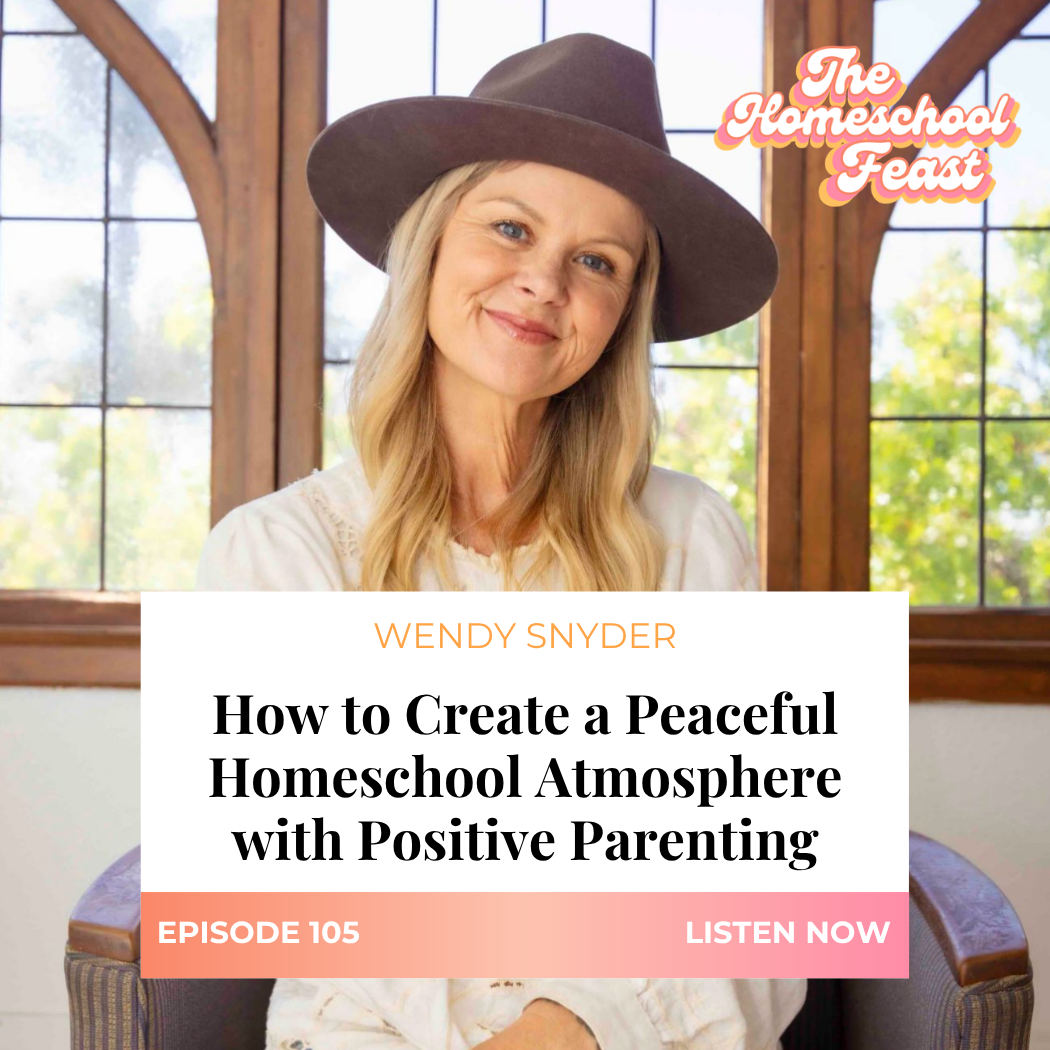
How to Create a Peaceful Homeschool Atmosphere with Positive Parenting
If you have ever tried to homeschool through sibling fights, math resistance, toddler meltdowns, big emotions, or your own reactive parenting moments, you know this truth deeply:
The atmosphere of the home matters.
Charlotte Mason famously said that education is an atmosphere, a discipline, and a life. In other words, our children are not only educated by the books they read or the lessons they complete. They are being shaped every day by the emotional and spiritual climate of the home.
In this episode of The Homeschool Feast, I welcomed Wendy Snyder, founder of Fresh Start Family and author of Fresh Start Your Family: Powerful Parenting to Restore Peace in Your Home, for a conversation about positive parenting, homeschool resistance, sibling conflict, and the powerful connection between Wendy’s work and Charlotte Mason’s philosophy. Wendy shares that parents often inherit the belief that a misbehaving child is a bad child and that a bad child means a failing parent. Her work helps parents shift that lens and begin seeing misbehavior as communication instead.
This is such an important conversation for homeschool families because homeschooling gives us so much time with our children, which is beautiful, but also very revealing. The lessons, the chores, the sibling dynamics, the transitions, the attitudes, and the resistance all become part of the atmosphere of the home.
And the good news is this: a peaceful homeschool does not require perfect children or perfect parents.
It requires a new way of seeing.
Children Are Born Persons, Not Problems to Manage
Charlotte Mason’s first principle is that children are born persons. That may sound obvious to us now, but it was a radical idea in her day. Children were often expected to be seen and not heard, managed rather than understood, controlled rather than respected.
Wendy’s book beautifully echoes this truth. She invites parents to look beneath the behavior and ask, “What is my child trying to communicate?”
When a child refuses math, snaps at a sibling, melts down over a routine, or resists a lesson, it is easy to assume the worst.
“She is being lazy.”
“He is trying to push my buttons.”
“They are making this harder than it needs to be.”
But Wendy reminds us that children have real human needs underneath their behavior. They need to feel powerful. They need to belong. They need to feel valuable. They need to feel loved. When those needs are unmet, children often communicate through behavior because they do not yet have the maturity or language to express what is happening inside.
This does not mean we ignore behavior. It means we interpret it differently.
A child is not a problem to manage.
A child is a person to know, guide, and love.
Homeschool Resistance Is Often a Power Struggle in Disguise
Every homeschool parent knows the feeling.
You finally sit down for math and your child says, “I hate this.”
You assign a reading and hear, “This book is dumb.”
You begin copywork and suddenly someone needs water, a snack, a bathroom break, and a different pencil.
It can feel personal. It can feel like disobedience. It can even make us question whether we are failing as homeschool parents.
But Wendy reframes these moments as opportunities to understand what kind of help the child needs. In the episode, she explains that many children fall into patterns of behavior that are connected to deeper needs, including power struggles, attention-seeking, revenge, or inadequacy. When a child resists a lesson, it may be a request for help feeling capable, powerful, or supported.
For homeschool parents, this is incredibly practical.
Instead of entering the tug-of-war, we can ask:
“What is my child communicating?”
“What need might be underneath this resistance?”
“How can I hold the boundary while giving my child a healthy sense of agency?”
This is where Wendy’s tools connect beautifully with Charlotte Mason’s teaching on the way of the will. Mason did not want children’s wills crushed. She wanted children to learn how to direct their wills toward what is right.
In homeschooling, the goal is not merely to get the math page finished.
The deeper goal is to help the child grow in self-government.
The Way of the Will and the Way of Reason
Charlotte Mason taught that children need help learning the way of the will. The will is strengthened when a child learns to choose what is right even when desire, mood, or resistance pulls in another direction.
But Mason also warned about the way of reason. Children can use reason to justify what they already want.
“I do not need math.”
“This is boring.”
“I will never use this.”
“This book is too hard.”
When a parent gets pulled into endless debate, the lesson can quickly become a battle of arguments. Wendy encourages parents to step out of that battle and instead offer calm, clear leadership.
One simple way to do this is by giving choices within boundaries.
For example:
“You do need to finish this math lesson. Would you like to do the first five problems with me or try them on your own first?”
“Would you like to read on the couch or outside on the porch?”
“Would you like to do copywork before snack or right after snack?”
The boundary stays firm, but the child receives a healthy measure of power. Wendy explains that choices, creativity, and empowerment can help children relax their resistance and feel like they are part of the solution.
That is not permissive parenting.
That is wise leadership.
Sibling Conflict Can Become a Training Ground
One of the biggest challenges in homeschooling is sibling conflict.
When children are together all day, every day, conflict is going to happen. There will be arguments over toys, space, noise, fairness, chores, games, and who sat in the favorite chair first.
Many of us assume our job is to stop the fighting.
But Wendy offers a powerful reframe: what if our job is to teach our children how to fight well?
In the episode, Wendy explains that sibling conflict is an opportunity to teach peaceful conflict resolution. Instead of always stepping in as judge, parents can coach children toward a “win-win” solution. Children can learn to say, “I feel…” and “I want…” and then work together to find a solution where both people are respected.
This is deeply connected to homeschool life.
The home is not just where academic lessons happen. It is where children learn how to live with other people. It is where they practice forgiveness, patience, communication, self-control, humility, and repair.
In that sense, sibling conflict is not an interruption to the real education.
It is part of the real education.
Atmosphere Is Shaped by How We Handle Mistakes
One of the most powerful parts of my conversation with Wendy was our discussion about atmosphere.
Charlotte Mason said atmosphere is one-third of education. Wendy described how children’s nervous systems are shaped by the “temperature” of the home, especially how mistakes are handled.
Do mistakes become four-alarm fires?
Does imperfection bring shame?
Does a child feel unsafe when they struggle, resist, or fail?
Or does the home communicate, “It is safe to be imperfect here, because this is how we learn”?
That line became one of my biggest takeaways from the whole conversation.
A peaceful homeschool atmosphere does not mean no one ever cries, argues, resists, or loses patience. It means mistakes are not the end of the story.
Repair is part of the atmosphere.
Wendy encourages parents to model repair by taking responsibility when they react poorly, apologizing without shame, and practicing a better response. This teaches children that mistakes are opportunities to learn, not proof that they are bad.
What a gift for our children to grow up in a home where humility is normal.
Where repair is practiced.
Where conflict does not mean disconnection.
Where imperfection is safe.
Positive Parenting and Charlotte Mason Fit Beautifully Together
At first glance, positive parenting and Charlotte Mason homeschooling may seem like separate conversations. But they are deeply connected.
Both honor the personhood of the child.
Both reject fear-based control.
Both value habit formation.
Both recognize the importance of atmosphere.
Both call parents to lead with wisdom, steadiness, and love.
Both are concerned with the formation of the whole person.
When we homeschool, we are not just trying to get through the checklist. We are forming children who can think, love, serve, create, forgive, persevere, and govern themselves.
That formation happens through books and ideas, yes.
But it also happens through the way we respond to resistance.
The way we handle sibling conflict.
The way we repair after mistakes.
The way we set boundaries.
The way we honor our children as persons.
The way we create an atmosphere where peace is not perfection, but a practiced way of life.
A Peaceful Homeschool Begins with a New Lens
If your homeschool has felt full of resistance, sibling fighting, or reactive moments, take heart.
You do not need to fix everything overnight.
Start by changing the question.
Instead of asking, “How do I make this stop?”
Ask, “What is my child trying to communicate?”
Instead of asking, “How do I win this power struggle?”
Ask, “How can I help my child practice using their will well?”
Instead of asking, “Why are my children fighting again?”
Ask, “What life skill can I help them learn here?”
Instead of asking, “Did we get everything checked off today?”
Ask, “What kind of atmosphere did we practice creating today?”
That shift alone can begin to change the emotional climate of your home.
And sometimes, that is where the fresh start begins.
About Our Guest:
Wendy Snyder is a Certified Positive Parenting Educator, Family Life Coach, and founder of Fresh Start Family, where she helps families ditch fear-based discipline and raise strong, emotionally healthy kids with compassion and confidence. Through her podcast, courses, and coaching programs, she’s guided thousands of parents to break painful generational cycles and create homes rooted in connection, peace, and purpose. She is the author of the upcoming book Fresh Start Your Family: Powerful Parenting to Restore Peace in Your Home. Wendy lives in Southern California with her husband Terry—her high school sweetheart—and their two kids, where they’re rewriting their own family legacy, one grace-filled day at a time.
Connect with Wendy Snyder:
Website: https://freshstartfamilyonline.com/
Podcast: https://freshstartfamilyonline.com/show/
Instagram: https://www.instagram.com/freshstartwendy/
Youtube: http://www.youtube.com/@wendysnyder-freshstartfamily
Fresh Start Your Family: Powerful Parenting to Restore Peace in Your Home! https://freshstartfamilyonline.com/book
Listen to the Full Episode
Listen to the full conversation with Wendy Snyder on The Homeschool Feast, where we talk about positive parenting, Charlotte Mason’s concept of atmosphere, homeschool resistance, sibling conflict, repair, strong-willed children, and the sacred work of creating a peaceful home.
Wendy’s book, Fresh Start Your Family: Powerful Parenting to Restore Peace in Your Home, is available wherever books are sold. She also offers resources for parents of strong-willed children through Fresh Start Family.
Stay connected
with news and updates!
Join our mailing list to receive the latest news and updates from our team.
Don't worry, your information will not be shared.
We hate SPAM. We will never sell your information, for any reason.
Hey there!