Listen to This When Your School Year Doesn’t Start the Way You Hoped
Oct 19, 2026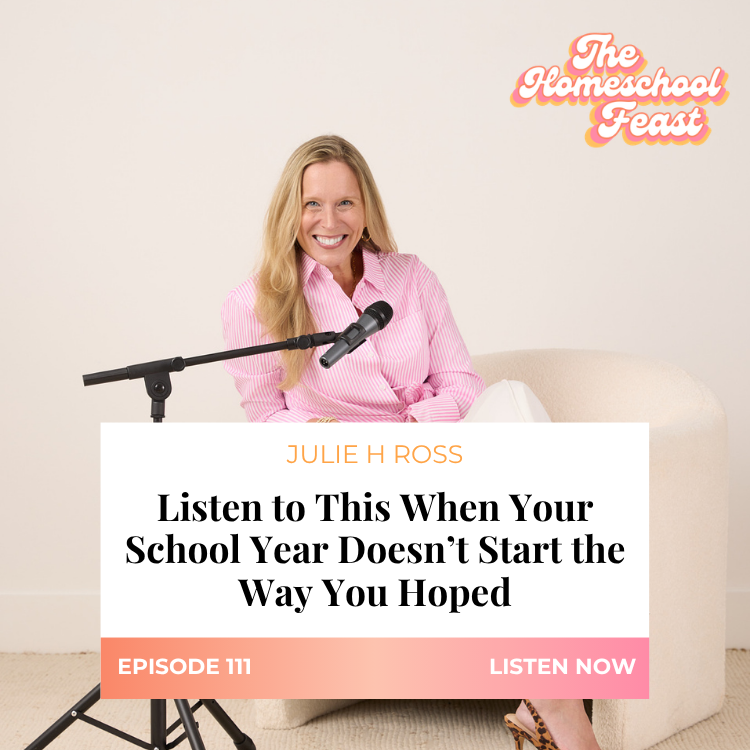
Listen to This When Your School Year Doesn’t Start the Way You Hoped
There is something about the beginning of a new school year that makes us believe this might finally be the year we get it all right.
We buy the books. We print the plans. We organize the shelves. Maybe we even make a beautiful schedule and imagine slow mornings, happy children, meaningful conversations, and everyone settling into a peaceful rhythm.
Then school starts.
And sometimes it does not look anything like what we pictured.
I was reminded of this recently when two things I had planned for my own daughters fell through right before we were supposed to begin. Suddenly I was rearranging things, rethinking plans, and trying to figure out what made sense for each of them now.
And I have been doing this for more than twenty years.
You would think at some point I would have figured out the perfect system and could just repeat it every year. But that has never happened, because my children are different every year. Our family is different every year. Life is different every year.
That is not a failure of planning. That is simply life.
I think this is one of the places where homeschool moms can put so much unnecessary pressure on themselves. We believe there is a perfect schedule, a perfect curriculum combination, or a perfect rhythm out there, and if we could just find it, everything would finally click.
But homeschooling is not about finding the magical system that will make real people behave predictably.
It is about learning to see the people in front of us.
Charlotte Mason’s schools used the motto, “I am, I can, I ought, I will,” and I keep coming back to those words because they say so much about what education is really meant to do.
Before we ever talk about what our children need to know, we have to remember who they are.
Charlotte Mason said that children are born persons. They are not empty buckets waiting for us to pour information into them. They are not a collection of standards or grade-level benchmarks. They are whole people made in the image of God.
That sounds simple, but it changes everything.
When I really see my child as a person, I stop asking only, “What should a seventh grader be doing?” and start asking, “What does this child need right now?”
Those two questions can lead to very different answers.
One child may be ready to move ahead. Another may need more time. One may suddenly be able to work independently. Another may need more connection this year. Sometimes the thing I thought would work beautifully just does not.
I have learned to hold all of that much more loosely than I used to.
I want to make plans. I believe in rhythms and habits and being intentional. But I never want to become so attached to the plan that I stop paying attention to the child.
That is part of what “I am” means to me. My child is a person, and so am I.
I am growing too.
Homeschooling has changed me as much as it has educated my children. I am not standing outside of this process as the expert who has everything figured out. I am a disciple too. I am learning patience. I am learning trust. I am learning to notice. I am learning how often my desire to control the outcome comes from fear.
That leads into the next part of the motto: “I can.”
Our children are capable of so much more than we often give them credit for.
Charlotte Mason said there is no education but self-education. I think that can sound intimidating until you understand what she meant. She was not saying we should leave our children alone to educate themselves. She was saying that the actual work of learning has to happen inside the child.
I can put beautiful ideas in front of my children, but I cannot think for them.
I can read them a living book, but I cannot decide what will capture their imagination.
I can take them outside and show them the world, but I cannot force wonder.
I can prepare the feast, but they have to do the digesting.
This is one of the hardest parts of homeschooling because we like evidence.
We like to know something worked.
We like check marks and completed pages because they make us feel like learning happened.
But some of the deepest growth is almost impossible to measure.
I cannot tell you how many times one of my children has brought up a book, an idea, or a conversation years after I thought it had disappeared into the abyss. Something had taken root that I could not see at the time.
That has taught me a great deal about trust.
Sometimes growth looks like excitement. Sometimes it looks like a beautiful narration. Sometimes it looks like silence. Sometimes it even looks like resistance.
That does not always mean nothing is happening.
This kind of education asks us to believe in slow growth.
It asks us to believe our children are capable of wrestling with ideas, making connections, developing opinions, and eventually taking ownership of their own learning.
And that matters far beyond school.
Children who learn to take ownership of their education become adults who know how to take ownership of their lives.
That is so much bigger than whether they got nine out of ten questions correct on a worksheet.
The “I ought” part of the motto takes us even deeper because now we are talking about who our children are becoming.
Education is never just academic. Whether we realize it or not, we are shaping our children’s imaginations every day.
The stories they hear matter.
The people they read about matter.
The ideas we place before them matter.
The atmosphere of our homes matters.
This is one of the reasons I love living books so much. A textbook can tell a child that someone was courageous. A story can let them experience courage.
A list can define generosity. A story can make them want to become generous.
That is the moral imagination.
We fill our children with pictures of what is good and beautiful and true so that when they are faced with their own choices, they have something inside of them to draw from.
And, again, this is not just for our children.
I need that too.
I need beauty. I need stories. I need Scripture. I need quiet. I need things that remind me what kind of mother and woman I want to be.
If all I consume is comparison, fear, and a running list of what I should be doing better, that becomes part of my atmosphere too.
We cannot create a life-giving home while constantly feeding ourselves things that drain the life out of us.
Then we come to “I will,” which may be the hardest part of all.
Knowing what matters is one thing. Doing it when we are tired, irritated, disappointed, or afraid is another.
The will is built slowly.
It is built when a child practices paying attention a little longer than they could before. It is built when they narrate even though they would rather say, “I don’t know.” It is built when they make a mistake and try again instead of deciding they are bad at something.
And our children are watching us build ours.
They see when the plan falls apart.
They see when we lose our patience.
They see when we have to change course.
But they can also see us apologize, adjust, and begin again.
I think sometimes we imagine that being a good homeschool mom means showing our children how to do everything well.
I am increasingly convinced that one of the greatest gifts we can give them is showing them what it looks like to keep going when we do not.
They do not need a perfect example.
They need a real one.
So if your school year did not start the way you hoped, I do not think your first job is to fix everything.
Look at your children.
Look at yourself.
Look at the season you are actually living in.
What do these particular children need from you right now?
What is bringing life into your home?
What is creating unnecessary friction?
What can you release?
What still matters even if everything else changes?
Sometimes the most life-giving thing we can do is stop trying to force our real life to match the imaginary one we created before school started.
The imaginary homeschool is always easier. The children cooperate. The schedule works. The mother is patient. Nobody gets sick. Nobody changes their mind. Nothing unexpected happens.
The real homeschool is messier.
But the real homeschool is also where the formation happens.
It is where we learn to trust God with our children. It is where we learn to see them as people instead of projects. It is where we learn that growth does not always look the way we expected. It is where our children learn that mistakes are not the end of the story.
And it is where we learn to begin again.
So if this year is already different from the one you planned, you have not ruined it.
You may simply be standing at the beginning of the year you are actually meant to live.
Stay connected
with news and updates!
Join our mailing list to receive the latest news and updates from our team.
Don't worry, your information will not be shared.
We hate SPAM. We will never sell your information, for any reason.
Hey there!