Worldschooling, Homeschooling and Creating a Boundless Education
Sep 16, 2026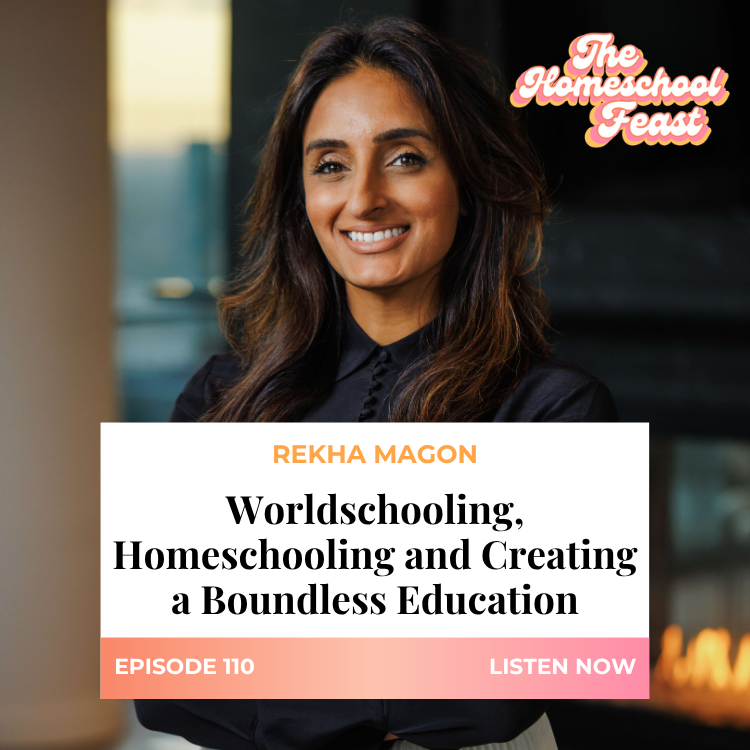
Worldschooling, Homeschooling and Creating a Boundless Education
There is a moment many homeschool moms know well. Nothing is necessarily wrong, and yet something still does not feel right.
That was part of Rekha Magon’s story. Before she became the co-founder and Chief Education Officer of Boundless Life, she was simply a mom watching her son begin kindergarten. He had friends. He was doing well academically. His teacher said everything was fine. But Rekha noticed something that could not be measured on a report card.
His spark was beginning to fade.
The curiosity that had always seemed so natural to him felt dimmer, and even though there was no dramatic crisis, she could not shake the feeling that this was not the education she wanted for him.
Eventually, that feeling led her to homeschooling.
What I loved about hearing Rekha tell this story is that she did not begin with a perfectly formed philosophy or a grand plan. She experimented. She tried different curriculums. She watched her children. She paid attention to what lit them up.
And slowly, education became less about recreating school at home and more about building a meaningful life together.
Her children cooked with their grandparents, spent time in nature, traveled, talked with people in different communities, started small businesses, and helped solve real problems. Learning became something woven into the fabric of their days rather than something that only happened during school hours.
That idea resonates so deeply with me because I think one of the greatest gifts of homeschooling is not simply that we get to choose our own curriculum. It is that we get to ask a much bigger question about what education actually is.
We get to look at our children and ask who they are becoming, what kind of experiences we want them to have, what kind of people we want them to know, and what kind of childhood we are building together.
For Rekha, travel became a natural extension of that philosophy.
She had grown up traveling with her own family and had experienced firsthand how much we learn when we are removed from what is familiar. There is something about being in a place where you cannot operate on autopilot. You have to pay attention. You have to figure things out. You notice how people live. You encounter foods, languages, customs, history, and ways of thinking that cannot be fully understood through a textbook.
You become more adaptable because you have to adapt. You become more humble because you are no longer the person who knows how everything works.
That kind of learning eventually helped inspire Boundless Life, a living and learning community that allows families to spend extended periods of time in different countries while children participate in experiential education and parents work remotely.
It is a fascinating model, and yes, it gave me a serious case of wanderlust.
But one of the things I appreciated most about my conversation with Rekha was that she never made international travel sound like the only way to give our children this kind of education.
Most families are not going to pack up and move to Italy for three months. Some families cannot travel internationally at all. Some are in a season where simply getting through the week feels like enough.
That does not mean our children have to miss out on a broad, culturally rich education.
Rekha talked about the ways she intentionally brought the wider world into her home even before Boundless Life existed. She used letters from different countries as a springboard for learning. She cooked foods from other cultures. She shared her own Indian and Sikh heritage with her homeschool community and invited family members to help children experience the food, clothing, music, and traditions of her culture.
That part of our conversation stayed with me because sometimes we think raising globally minded children requires a passport.
Often it begins with curiosity.
It begins with getting to know the people already around us.
It begins with being willing to step outside the people, places, and routines that feel most familiar.
And if I am honest, that is often the harder part.
Kids are usually pretty good at this. They will walk onto a playground, see another child, and start playing. They are not overthinking whether they will sound awkward or whether someone will think they are strange.
We adults are often the ones who have learned to stay comfortable.
There is nothing wrong with stability. Children need it. But growth usually asks us for a little discomfort too.
Sometimes that discomfort looks like international travel. Sometimes it looks like joining a new community. Sometimes it looks like changing the way we homeschool. And sometimes it simply looks like admitting that an assumption we have always carried about education may not actually be true.
That is what I loved about Rekha’s use of the word boundless.
She was not talking about a life with no structure or responsibility. She was talking about a life that is not unnecessarily limited by fear.
How much of what we believe about education comes from what is actually best for our children, and how much comes from what we have simply been told is normal?
That question is worth sitting with.
Near the end of our conversation, Rekha said something I cannot stop thinking about. Education should not merely prepare children for life someday. Education should be life itself.
I think that is one of the most beautiful things about homeschooling.
Our children are not future people. They are people now.
They do not need to spend eighteen years waiting for real life to begin. They can contribute now. They can create now. They can serve now. They can build meaningful relationships now. They can solve real problems now. They can experience beauty, disappointment, joy, challenge, wonder, and growth now.
Of course we want to prepare them for adulthood. But sometimes we become so consumed with the future that we miss the life happening right in front of us.
We worry about high school, transcripts, college, and whether we are doing enough. Meanwhile, there is a child sitting across from us who is curious about something today.
There is a conversation we could have today.
There is a place we could explore.
There is a person we could get to know.
There is a whole life being lived right now.
At the end of the episode, I asked Rekha what she would tell the younger version of herself.
Her answer was simple: trust your gut and follow your child.
I think many of us need that reminder.
There are more homeschool resources and options available now than ever before. That can be wonderful, but it can also make us believe the answer must be somewhere outside of us.
Sometimes the better thing is to get quiet enough to pay attention to the actual children in front of us and to the life we are building together.
You do not have to recreate someone else’s homeschool. You do not have to travel the world. You do not have to chase every opportunity.
Maybe a boundless education is simply one where fear is not making all the decisions.
One where there is room to question, to wonder, to follow curiosity, and to create a life that fits the people who are actually living it.
That kind of education may look very different from family to family.
And I think that is exactly the point.
Connect with Rekha Magon:
- Boundless Life Website
- Rekha's LinkedIn
- Youtube: Worldschooling TV channel
- Instagram: @boundlesslife
Stay connected
with news and updates!
Join our mailing list to receive the latest news and updates from our team.
Don't worry, your information will not be shared.
We hate SPAM. We will never sell your information, for any reason.
Hey there!