
How to Raise Generous, Compassionate, and Globally Minded Kids
Aug 26, 2026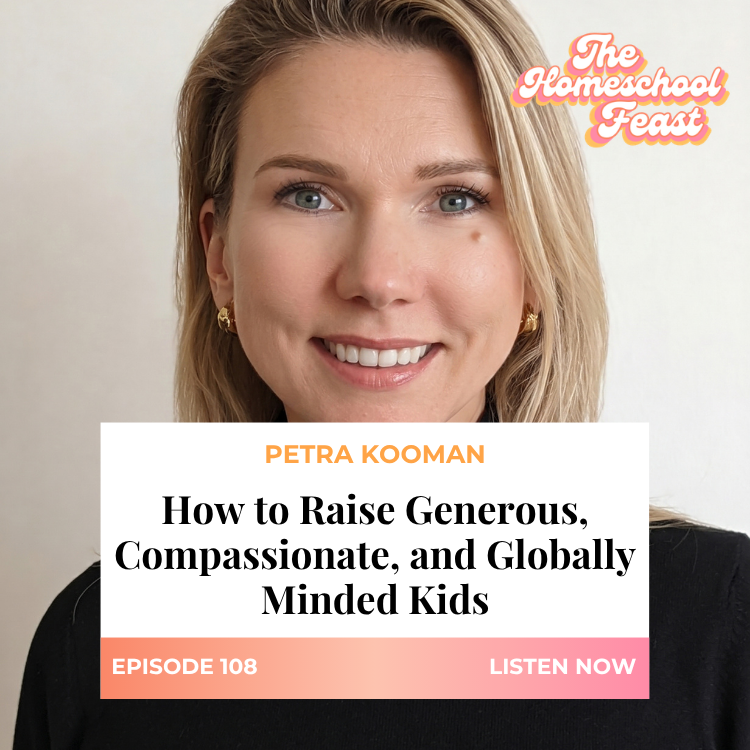
How to Raise Generous, Compassionate, and Globally Minded Kids
How do we teach our children about poverty, injustice, and suffering without overwhelming them?
Most parents want to raise children who are kind, generous, and aware of the world beyond themselves. We want them to notice when others are hurting. We want them to care about people whose lives look very different from their own. We want them to understand that they can be part of bringing hope and healing into the world.
But those conversations can feel difficult.
How much should we share with young children? How do we talk about hunger, homelessness, poverty, or human trafficking without creating fear? How do we help children care deeply without making them feel responsible for fixing every problem?
In a recent episode of The Homeschool Feast Podcast, I spoke with Petra Kooman from Compassion International about how families can raise globally minded children in ways that are practical, age-appropriate, and filled with hope.
Petra has supported Compassion for nearly twenty years and now serves on its global public relations team, where she helps identify and share stories from children and families around the world. She is also a mother of two who is intentionally raising her own children with generosity, simplicity, empathy, and an awareness of the needs of others.
Her encouragement was both meaningful and freeing: you do not have to completely redesign your family life to raise compassionate children.
You can begin with one small step.
Start With What Your Child Can Understand
Children do not need to know every painful detail about the world in order to develop compassion.
Petra explained that parents can think of these conversations on a sliding scale. What you share should depend on your child’s age, sensitivity, maturity, and ability to understand what they are hearing.
A young child may be able to understand that some children do not always have enough food, that some families cannot afford to send their children to school, or that some people do not have safe homes.
Those are real and important truths, but they can be communicated simply.
More complex topics, such as human trafficking or large systems of injustice, may need to wait until a child is developmentally ready to process them.
This is one of the great gifts of homeschooling. We know our children well. We can notice how they respond, answer their questions gently, and adjust the conversation based on what they are prepared to carry.
The goal is not to hide hardship from our children. It is to introduce truth with wisdom.
Make Global Issues Personal
Large problems can feel abstract to children.
“Global poverty” is difficult to picture. One child with a name, a face, a family, and a home country is much easier to understand.
Petra shared how sponsoring a child through Compassion has helped her own children make a personal connection with someone in another part of the world. They can see his picture, find Brazil on a map, write letters, receive letters in return, and pray for needs that are specific to his life and community.
That personal connection transforms an issue into a relationship.
Children begin to understand that poverty is not simply a topic or statistic. It affects real people with personalities, dreams, talents, families, and stories.
This also helps guard against pity.
We do not want children to see people experiencing poverty only as helpless or needy. We want them to recognize the dignity and worth of every person.
The goal is not to teach, “We have everything, and they have nothing.”
The goal is to teach, “This is a person made in the image of God. Their life matters. Their family matters. We can draw near with humility, love, prayer, and practical support.”
Generosity Is About More Than Money
When we hear the word generosity, we often think first about financial giving.
Money is certainly one way families can be generous, but it is not the only way.
Generosity can include:
- Giving time
- Sharing attention
- Offering encouragement
- Praying faithfully
- Writing letters
- Sharing possessions
- Practicing hospitality
- Forgiving others
- Assuming the best
- Giving someone space to be fully themselves
Petra described generosity as a willingness to notice another person and respond with care.
Her family keeps useful supplies in the car so they can offer water to someone in need. They pass clothing along to families who can use it. They write to their sponsored child and pray for his family and community.
These actions may seem small, but they teach children that generosity is not limited to special occasions.
It is a way of moving through the world.
Simplicity Creates Space for Generosity
Simplicity and generosity are deeply connected.
When our lives are overcrowded with possessions, commitments, and constant rushing, it becomes more difficult to notice the needs around us.
Petra talked about the importance of creating margin.
Margin gives us time to look up.
It allows us to notice the person standing at the stoplight, the family who could use a bag of clothing, the child who needs encouragement, or the neighbor who may need help.
This does not mean every family will live slowly in every season. Some seasons are naturally intense. There are babies, health challenges, jobs, moves, activities, and unexpected needs.
But busyness does not have to become the permanent pattern of family life.
We can look for small ways to make room.
That may mean leaving ten extra minutes before an appointment, eating dinner together more often, putting down our phones, or simply asking our children, “Who did you notice today?”
Simplicity is not only about owning fewer things.
It is about creating enough space to live according to what we say matters.
Help Children Release the Burden
Some children are especially tenderhearted.
They hear about hunger, war, homelessness, or injustice and immediately feel that they must solve the entire problem.
They may become anxious, discouraged, or weighed down by needs that are far beyond their ability to address.
Petra shared that one of her own children can easily become burdened in this way. She helps that child recognize the need, respond in a small and faithful way, and then release the larger burden to God.
They may pray for their sponsored child.
They may pray for someone they saw in their community.
They may give or serve where they can.
Then Petra reminds her child that God is bigger than they are and cares even more deeply than they do.
This is such an important lesson.
Our children can care without carrying the world.
They can act without believing everything depends on them.
They can pray without needing to understand every mystery.
As parents, we do not always need to provide a perfect theological explanation for why suffering exists. Sometimes the most honest answer is, “I do not fully understand either. But I know God sees, God cares, and we can bring this to Him.”
Pray Specifically, Then Trust God
Prayer is one of the most meaningful forms of generosity because it gives our attention and concern to another person before God.
Families may not always know how to pray about a large issue like poverty, but they can begin with simple, specific prayers.
You might pray:
“God, please provide food for children who are hungry.”
“Please protect families who are not safe.”
“Please give parents the help they need to care for their children.”
“Please help children have access to school, medicine, and clean water.”
“Please strengthen churches that are serving their communities.”
“Please show our family one way we can help.”
Children can also pray for a specific person or family they know about.
After praying, we can remind them that God does not ask them to stay awake carrying every sadness.
We can say, “We have prayed. We will do what we can. Now we can trust God with what is too big for us.”
That is not indifference.
It is faithful surrender.
Use Stories to Build Compassion
Stories help children understand experiences that are different from their own.
Living books, missionary biographies, maps, letters, photographs, music, and stories from other cultures can all help widen a child’s view of the world.
Stories allow children to see both hardship and beauty.
They can learn that people living in poverty still experience joy, faith, family, celebration, courage, creativity, and hope.
Petra’s work is centered on storytelling because stories move people.
They help us see beyond labels.
They remind us that every person has a name, a history, relationships, and dreams.
As homeschool parents, we have a beautiful opportunity to place those kinds of stories into our children’s hands.
Travel Can Give Children Roots and Wings
Petra described travel as one way we can give children both roots and wings.
Roots come from the security of home, faith, family traditions, dependable rhythms, and a deep sense of belonging.
Wings come from encountering the unfamiliar.
Travel helps children see that their own habits, foods, language, routines, and culture are not the center of the world.
It also builds adaptability.
Flights are delayed. Luggage disappears. Food tastes different. Communication becomes more difficult. Plans change.
Those moments can be uncomfortable, but they help children become resourceful, flexible, and aware of other people.
Of course, international travel is not realistic for every family or every season.
Petra emphasized that families can cultivate the same spirit of curiosity and awareness close to home.
You might:
- Visit a nearby city or town
- Eat at a restaurant owned by someone from another culture
- Attend a cultural festival
- Build friendships with families from different backgrounds
- Read books set in other countries
- Learn about missionaries
- Listen to music from another culture
- Study a country on the map
- Visit a diverse church
- Learn about local organizations serving immigrants or refugees
Adventure does not have to be expensive or complicated.
Sometimes it simply means stepping outside what is familiar.
Let Children See Where Their Gifts Go
Children often find it easier to give something away when they understand who will receive it and how it will be used.
Petra shared that when her daughter outgrows clothing, they often pass it along to a family they know. Her daughter then gets to see another little girl enjoying the dress she once wore.
The item has a second life.
That experience makes generosity tangible.
Even when families donate to an organization, parents can explain what the organization does and how the donation helps.
Ask questions such as:
“Who might use this?”
“How could this bless another family?”
“What happens to the money raised?”
“Why are we choosing to give this away?”
This helps giving become meaningful rather than simply another round of cleaning out a bedroom.
Do Not Overcomplicate It
One of Petra’s most practical pieces of advice was this:
Do not overcomplicate it.
Parenting is a marathon, not a sprint.
You do not need to create an elaborate global studies program, overhaul your schedule, travel internationally, sponsor several children, and begin a family service project all at once.
Choose one thing.
Have one conversation at dinner.
Pray for one child.
Read one book.
Give away one bag of clothes.
Keep water in the car.
Try one new food.
Find one country on the map.
Write one letter.
Small practices, repeated over time, shape character.
Compassion Is Part of an Abundant Life
Why does all of this matter?
Because compassion and generosity are not simply extra qualities we hope our children develop.
They are central to a life of meaning.
A child who grows up focused only on personal comfort, success, and possessions may eventually discover that life becomes very small.
We were created for relationship, service, love, and community.
Our flourishing is connected to the flourishing of others.
Teaching children to live generously is not only good for the people they serve. It is also good for them.
It helps them experience a richer, more connected, more purposeful life.
And for Christian families, it reflects the heart of God.
We love because He first loved us.
We show mercy because we have received mercy.
We draw near because Christ drew near to us.
A Story of Hope
Near the end of our conversation, Petra shared a story about a mother in an African country who gave birth to triplets.
Because of a stigma associated with triplets in her community, her husband left her and her family abandoned her. She was alone, vulnerable, and afraid, with three babies to care for.
She sat in a field and cried out to God because she did not know where else to go.
A volunteer from a local church connected with Compassion heard her crying.
That person stopped.
They listened to her story.
The church community gathered around her. They helped her find a safe place to live. They protected her. They helped enroll her children in Compassion’s program.
Those triplets are now eight years old.
They are nourished, doing well in school, connected to a church community, and growing up knowing they are loved.
That story captures what compassion looks like.
Someone noticed.
Someone drew near.
Someone acted.
A church responded.
A family’s future changed.
One Small Step
You do not need to fix the whole world.
You do not need to make your children carry every sorrow.
You do not need to add another overwhelming responsibility to your homeschool.
You can simply begin by helping your children notice.
Notice the person.
Notice the need.
Notice the gift they can offer.
Notice the ways God may be inviting your family to pray, give, serve, welcome, or learn.
Then take one small step together.
That is how compassion grows.
That is how generosity becomes a way of life.
That is how we raise children who understand that they are not the center of the universe, but they are a meaningful and beloved part of God’s work in the world.
About Our Guest
Petra Kooman serves on the global public relations team at Compassion International, where she helps identify and share stories that inspire people to care for children and families experiencing poverty.
She has supported Compassion for nearly twenty years and has worked for the organization for the past three years. Petra has spent much of her career using storytelling to raise awareness about poverty alleviation and human trafficking.
She is also a wife and mother of two children, ages six and nine, whom she is intentionally raising with simplicity, generosity, empathy, and an awareness of the world beyond their own community.
Connect with Petra Kooman
- Website: Compassion International
- Instagram: @Compassion
Stay connected
with news and updates!
Join our mailing list to receive the latest news and updates from our team.
Don't worry, your information will not be shared.
We hate SPAM. We will never sell your information, for any reason.
Hey there!