What History’s Heroes Can Teach Us About Creating an Inspired Homeschool
Jul 20, 2026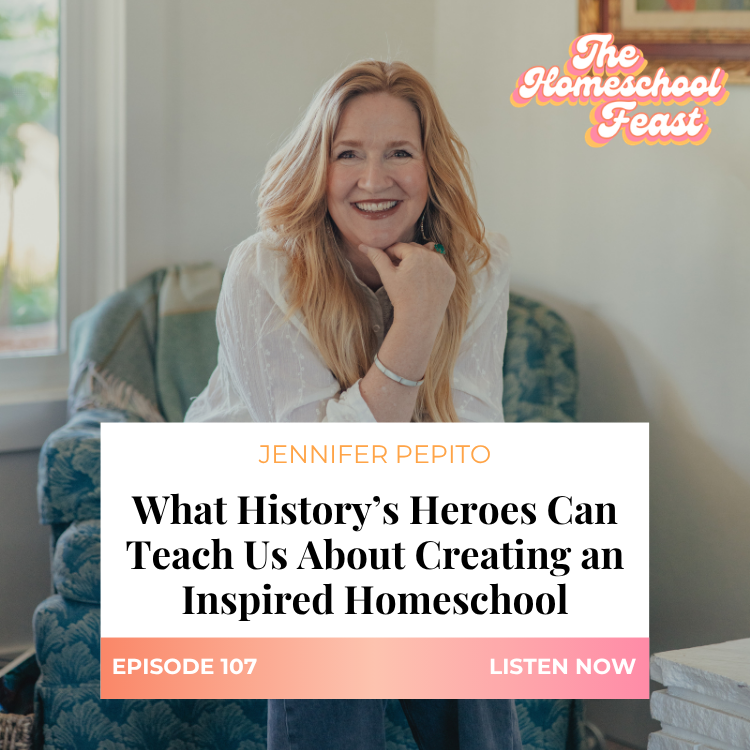
What History’s Heroes Can Teach Us About Creating an Inspired Homeschool
What if the goal of homeschooling is not to recreate school at home—but to create an environment where curiosity, character, creativity, and calling can grow?
That is the heart of my conversation with Jennifer Pepito, longtime homeschool mother, founder of The Peaceful Press, host of the Restoration Home podcast, and author of The Inspired Homeschool: How History’s Heroes Light a Path Toward Joyful, Confident Learning.
In her new book, Jennifer looks at the childhoods and educational experiences of ten influential people, including C.S. Lewis, Laura Ingalls Wilder, Leonardo da Vinci, Booker T. Washington, Blaise Pascal, and Joan of Arc. Their stories are wildly different. Some were taught by parents. Some had tutors or mentors. Some had very little formal schooling at all.
And yet, certain themes appear again and again.
These men and women were given ideas worth thinking about. They had adults who noticed their gifts. They had room to observe, explore, read, create, and work. Their education was not always conventional, but it helped form people who would go on to shape literature, art, science, culture, and faith.
That is encouraging for homeschool parents because it reminds us that there is not one perfect formula.
Homeschooling Is Not About Recreating the Classroom
Many parents begin homeschooling because something about conventional education is no longer working for their child. But it is easy to bring children home and then recreate the same system around the kitchen table.
We add long assignments, endless worksheets, hours of screen-based instruction, and rigid schedules because those things look like school.
But homeschooling gives us the opportunity to ask a better question:
What kind of education helps a child become fully alive?
Jennifer points out that the remarkable people she studied were not all following one carefully standardized plan. Some were deeply academic. Others learned through work, reading, observation, conversation, mentorship, and real life.
The common thread was not a particular curriculum. It was an environment that allowed their personhood and gifts to develop.
That does not mean education should be careless or unstructured. It means our structure should serve the child rather than force the child into an artificial system.
An inspired homeschool can include rich books, short lessons, meaningful work, time outdoors, strong habits, beauty, conversation, creativity, and opportunities to follow a child’s growing interests.
An Inspired Homeschool Begins with an Inspired Parent
One of the most important ideas in our conversation was that children often catch more from us than we consciously teach them.
We can buy beautiful books and thoughtfully plan lessons, but our children are also watching how we live.
Do they see us reading?
Do they see us asking questions?
Do they see us noticing beauty, learning new things, trying creative work, and remaining interested in the world?
Or do they see us rushing through a checklist and collapsing into distraction when the work is over?
Jennifer explains that parents do not need to be highly educated, exceptionally talented, or financially privileged to create an atmosphere of learning. Booker T. Washington’s mother had almost no educational opportunity herself, yet she recognized and supported her son’s desire to learn. She did what she could with what she had.
That kind of attention matters.
A child does not need a parent who knows everything. A child needs a parent who believes learning is worthwhile and who is willing to say, “Let’s find out.”
Our own curiosity can become part of the atmosphere of our homes.
Gentle Does Not Mean Easy
Jennifer and I also talked about the growing assumption that a gentle education must be an academically weak one.
But gentleness and rigor are not opposites.
Reading the Bible, Shakespeare, history, poetry, classic literature, and living science books is not academically shallow. Asking children to narrate what they have read, form connections, observe carefully, and express their own thoughts requires real intellectual work.
Gentleness means we respect children as persons.
It means we do not force work that is developmentally inappropriate simply because a system says a child should produce a certain outcome by a certain age. It means we do not confuse unnecessary volume with meaningful learning.
A seven-year-old does not need to write an essay to prove that learning is happening. A young child may be doing far more important intellectual work while listening to a rich story, retelling it in their own words, building something, observing a caterpillar, or acting out a scene with siblings.
Gentle education can still be orderly, disciplined, and deeply challenging.
It simply recognizes that children grow in stages and that education should honor the person in front of us.
Strong Habits Create Freedom
At first, habits can sound like the opposite of inspiration.
We may imagine that routine will make our homes rigid or dull. But habits can actually create the space in which creativity and peace become possible.
Jennifer discusses Benjamin Franklin, who was deeply interested in habits, order, and intentional use of time. His routines did not prevent him from inventing, writing, studying, and contributing to public life. They supported that work.
The same can be true in our homes.
When children know how to begin the morning, care for their belongings, complete household responsibilities, listen during lessons, and move through a familiar rhythm, the day requires less constant correction and negotiation.
That leaves more room for reading aloud, conversation, nature walks, creative projects, and spontaneous interests.
Habits do not have to be established all at once. Jennifer encourages families to begin small.
Choose one habit that would bring more peace to your home. Practice it consistently. Then add another.
The goal is not perfection. The goal is to create rhythms that help the family flourish.
Notice Your Child’s Gifts
Another powerful theme in the lives Jennifer studied was the role of parents and mentors who noticed a child’s particular gifts.
Leonardo da Vinci had room to observe and create. C.S. Lewis was shaped by books, discussion, and individual mentorship. Berthe Morisot’s family supported her artistic development at a time when women had limited access to formal art education.
As children grow, homeschooling gives parents the freedom to become more intentional about those emerging abilities.
A teenager who shows unusual interest in science may benefit from a mentor, college course, apprenticeship, or specialized program. A child drawn to writing may need time, books, feedback, and opportunities to share their work. A student interested in music, mechanics, animals, business, or design may need a path that looks different from a standardized high school plan.
Parents do not have to teach every subject themselves.
One of the gifts of homeschooling is the ability to seek out people and experiences that can help children develop beyond the parent’s own knowledge.
Our job is not to be the source of everything. Sometimes our job is simply to notice, encourage, and connect.
Hard Seasons Can Still Form Something Beautiful
Jennifer’s reflections on Elizabeth Goudge were especially meaningful.
Goudge wrote beautiful stories about faith, family, relationships, and home, even though her own life included significant limitations and she never had a family of her own. Her gifts developed within hardship, not outside of it.
That is an important reminder for homeschool mothers who feel that their difficult circumstances are ruining everything.
Perhaps you are homeschooling through chronic illness, grief, financial pressure, marriage struggles, a child’s special needs, or your own exhaustion.
It may not look like the peaceful picture you once imagined.
But a hard season is not necessarily a wasted season.
Children can learn compassion, perseverance, service, flexibility, faith, and hope through watching a parent walk honestly and faithfully through difficulty.
Our limitations may shape the education, but they do not automatically destroy it.
Sometimes what is being formed in a season of hardship is deeper than what could have been produced through an easy one.
We Are Responsible for Faithfulness, Not Outcomes
Perhaps the most tender part of our conversation came when Jennifer spoke about Joan of Arc and her mother.
Joan’s story ended in terrible injustice. Her mother continued to plead for her daughter’s innocence, and Joan was eventually exonerated after her death.
For parents of teens and adult children, that story carries a powerful reminder.
We can love our children, teach them truth, fill their lives with beauty, pray for them, and provide a faithful education. But we cannot control every choice, struggle, or outcome.
Many homeschool parents begin with an unspoken formula: if I do the right things, my children will become exactly what I hoped.
Real life is usually messier.
Children become adults. They wrestle with questions. They make choices. They go through painful seasons. They may not follow the timeline or path we imagined.
That does not mean our work was meaningless.
It means our identity and hope cannot rest entirely in the visible results of our parenting.
We are called to remain steady. To pray. To love. To hold to what is true. To trust that God is still at work in stories we cannot yet see clearly.
Creating Your Own Inspired Homeschool
An inspired homeschool does not require a perfect schedule, an expensive curriculum, or a mother who always feels confident.
It begins with a vision.
What kind of people are you hoping to raise?
What do you want the atmosphere of your home to communicate?
What ideas, stories, habits, relationships, and experiences will help your children grow into who God created them to be?
You can begin simply.
Read something beautiful together.
Take a walk and notice what is growing.
Teach one useful habit.
Ask your child what they are curious about.
Make time for work, rest, conversation, and creativity.
Let go of the pressure to imitate someone else’s homeschool perfectly.
The stories in The Inspired Homeschool remind us that education has always taken many forms. The goal is not to reproduce a system. It is to cultivate a home where children are known, where ideas are alive, where gifts are nurtured, and where learning becomes part of a meaningful life.
That kind of education can shape more than academic success.
It can shape a person.
Resources Mentioned
- The Inspired Homeschool by Jennifer Pepito
- Habits for a Sacred Home by Jennifer Pepito
- The Peaceful Press
- The Charlotte Mason Companion by Karen Andreola
- In Vital Harmony by Karen Glass
- Simplicity Parenting by Kim John Payne
- Gifted Hands by Ben Carson
- Personal Recollections of Joan of Arc by Mark Twain
- The Awakening of Miss Prim by Natalia Sanmartin Fenollera
About Our Guest
Jennifer Pepito is the host of the Restoration Home podcast, the bestselling author of Habits for a Sacred Home, and the founder of The Peaceful Press. She has spent 27 years homeschooling her seven children, and her work helps families create peaceful homes rooted in faith, meaningful habits, rich ideas, and strong relationships.
Her newest book, The Inspired Homeschool: How History’s Heroes Light a Path Toward Joyful, Confident Learning, explores the educational lives of influential writers, artists, scientists, leaders, and people of faith while offering practical encouragement for today’s homeschool families.
Connect with Jennifer Pepito
Website: The Peaceful Press
Instagram: @jenniferpepito
Facebook: @thepeacefulpress
Pinterest: @thepeacefulpress
Podcast: Restoration Home
Stay connected
with news and updates!
Join our mailing list to receive the latest news and updates from our team.
Don't worry, your information will not be shared.
We hate SPAM. We will never sell your information, for any reason.
Hey there!